PhD Student — University of Alberta

Devon
Yanitski

I study minds and language models: psychometrics from language embeddings, the neural correlates of human memory, and LLM interpretability tools applied to human minds.

Department of Psychology, University of AlbertaComputational Memory Lab

Psychometrics from embeddings

Can the geometry of an embedding space stand in for human survey responses? Semantic Factor Analysis recovers latent psychological structure from item text alone.

What's latent in language models

Opening up language models — sparse-autoencoder feature steering, and what clamping a single interpretable feature reveals about the computations running inside.

loading the rat…

Qwen3.5-2B with a slider to steer the sparse-autoencoder feature corresponding to rats (#26631). A rat-themed take on Golden Gate Claude. This is a small LLM and may produce repetitive output.

sparse autoencodersfeature steeringQwen3.5-2BRats
GitHub →
Paperunpublished

A Computational Analog of OCD in LLMs Through Sparse-Autoencoder Feature Steering

Devon Yanitski

OCD is defined by intrusive, unwanted thoughts a person cannot dismiss on command and that grow stronger when suppressed. We use sparse-autoencoders (SAEs) to amplify features in LLMs that represent obsessive concepts. This produced the defining marks of clinical obsession: the model could not suppress the theme when instructed to, whereas the same theme from ordinary prompting stopped on command, and telling the model not to think about the theme raised the feature's activity further.

computational psychiatrySAE steeringOCDinterpretability

Are LLMs dual-process thinkers?

Do language models choose like utilitarians, and does reasoning shift their judgements the way it shifts ours? Measuring when LLMs replicate human behaviour.

Paperunpublished

Reasoning in LLMs Causes More Utilitarian Judgements

Devon Yanitski

Does the human dual-process finding — that reasoning increases utilitarian moral judgment — extend to LLMs? Across 122 open-source models run on a 40-item moral-dilemma battery, switching on reasoning raised utilitarian responding and lowered altruism and deontology: the human dual-process signature, reproduced in a system with no affect, kin, or evolved morality.

moral psychologyreasoning122 LLMsprocess dissociation
Paperunpublished

LLMs Validate The Cognitive Reflection Test

Devon Yanitski

122 open-source LLMs took an updated Cognitive Reflection Test (Meyer et al., 2024), each item answered twice — once on intuition, once with reasoning. Holding arithmetic ability fixed, engaging reasoning alone moves the score, supporting the claim that the CRT is separable from ability — a cleaner demonstration than human data, where CRT scores confound ability, disposition, and motivation.

cognitive reflection testreasoning122 LLMsMeyer 2024

Improving LLM-assisted research

I am building the scaffolding that lets AI agents carry out autonomous psychology research — starting with how they ground themselves in the literature.

Viewing the live brain

Real-time EEG tooling — Muse Visualizer turns the raw waveforms and oscillatory band activity from a consumer headband into highly customizable, artistic live representations of the brain.

An LLM that only writes how-tos

Language models fine-tuned to answer any question as a step-by-step how-to article, with an image model that draws a picture for every step. The sillier the question, the better.

WikiQwen » how-to

How to Put an EEG Cap on Your Cat

Written by WikiQwen-9B · Illustrated by WikiQwen-Illustrator-7B

Electroencephalograms (EEG) are used to measure brain activity in cats. The EEG cap is used to record the electrical activity of the brain, and it is important to have a comfortable and secure fit for accurate readings. Putting an EEG cap on your cat may seem challenging, but with patience and gentle handling, you can do it at home or in a veterinary clinic.

Part1

Preparing for the ProcedurePart 1 of 2

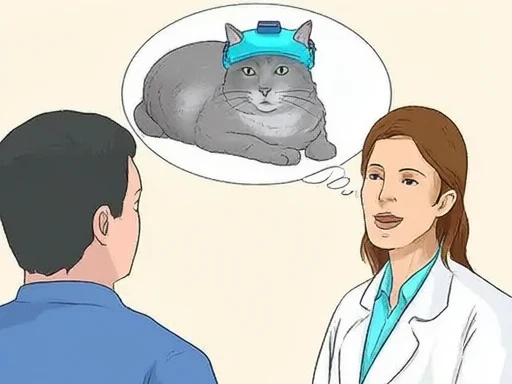
A veterinarian in a white coat speaks to a person in a blue shirt. A thought bubble above them shows a gray cat wearing a blue EEG cap, illustrating the procedure being discussed.
1

Talk to your vet about the procedure. If your cat needs an EEG, make sure you understand the procedure before you begin. Ask your vet any questions you may have about the process, such as how long it will take, what it will feel like for your cat, and how often they will need to wear the EEG cap.

  • Your vet may also recommend certain medications to help your cat stay calm and relaxed during the procedure.
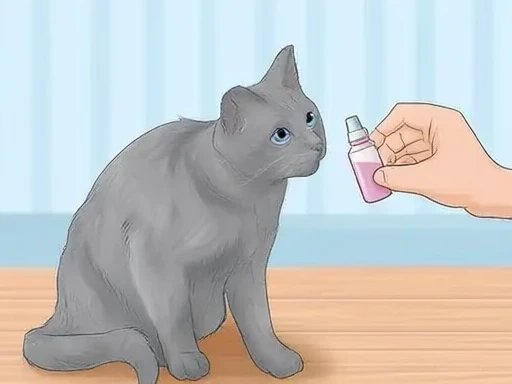
A gray cat sits on a wooden floor while a hand holds a small bottle of sedative near its mouth. The background features a light blue wall with vertical stripes. The cat looks up attentively as the medication is offered.
2

Give your cat a sedative if necessary. If your cat is anxious or restless, you may want to give them a mild sedative before putting on the EEG cap. This can help them relax and make the process easier. Talk to your vet about the best type of sedative to use and how much to give your cat.

  • Avoid using sedatives that could cause side effects such as nausea, vomiting, or lethargy.
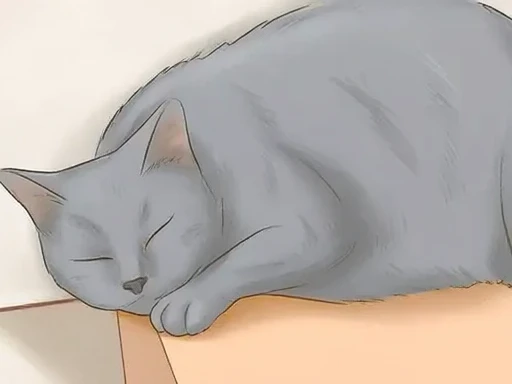
A gray cat lies on a light-colored floor with its head resting on a wooden surface. The cat's eyes are closed, and its body appears relaxed, indicating it is calm and ready for the next step in the process.
3

Make sure your cat is calm. It is important to wait until your cat is relaxed before you put on the EEG cap. If your cat is agitated or restless, try calming them down by petting them, talking to them softly, or giving them a treat.

  • You may also want to play some soothing music or turn on a television to help distract your cat.
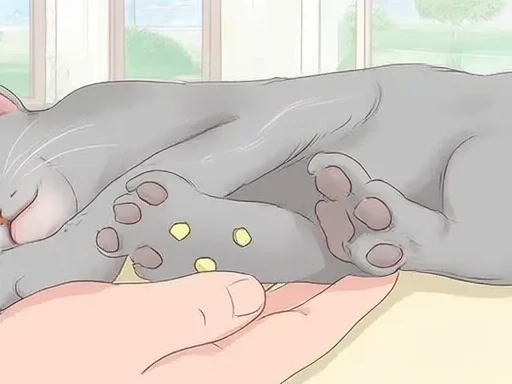
A hand holds a gray cat's paw, which has several small adhesive electrodes placed on the pads. The cat is lying on a light-colored surface, and the background includes a window with a view of greenery outside.
4

Place adhesive electrodes on your cat's paws. Before you put on the EEG cap, you will need to attach adhesive electrodes to your cat's paws. These electrodes will help conduct electricity from the brain to the EEG machine. Use a gentle touch when placing the electrodes to avoid startling your cat.

  • The electrodes should be placed on the pads of your cat's paws.
  • Your vet or technician may do this for you if you are not comfortable handling the electrodes yourself.
Part2

Putting on the EEG CapPart 2 of 2

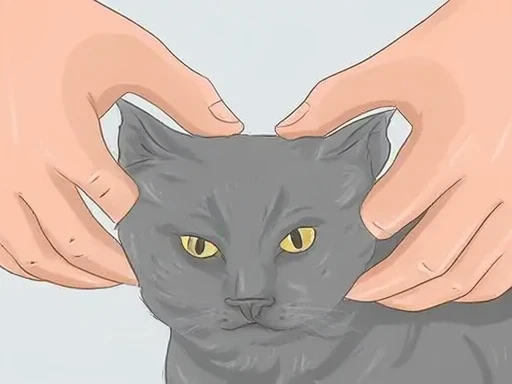
A pair of hands gently holds the head of a gray cat. The fingers are positioned carefully around the cat's ears and face, demonstrating a gentle touch. The background is a simple, solid color.
1

Use a gentle touch. Cats can be easily startled or frightened, so it is important to handle them with care. When putting on the EEG cap, use a gentle touch and speak to your cat in a soft voice to help them feel calm and relaxed.

  • Avoid holding your cat too tightly or squeezing their body.
  • Be patient with your cat and allow them to adjust to the new sensations.
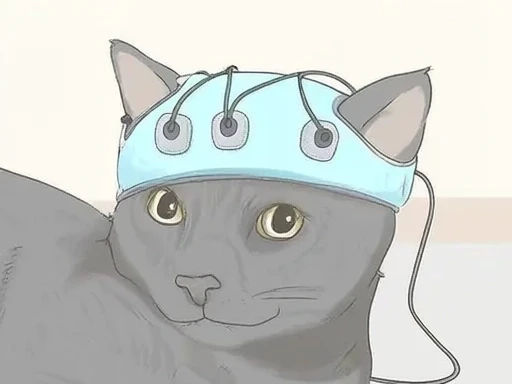
A gray cat wears a light blue EEG cap with four visible electrode pads attached to its scalp. The cap fits snugly over the head, ensuring the electrodes make proper contact. The background is plain and light-colored, focusing attention on the cat and the cap.
2

Fit the EEG cap onto your cat's head. Once the electrodes are in place, you can put on the EEG cap. Start by placing the cap over your cat's head, making sure the electrodes are in the correct position. Then, adjust the cap to ensure a snug fit.

  • Some EEG caps have adjustable straps to help secure them in place.
  • If your cat resists the cap, try breaking it into smaller steps and rewarding your cat with treats or praise after each step.
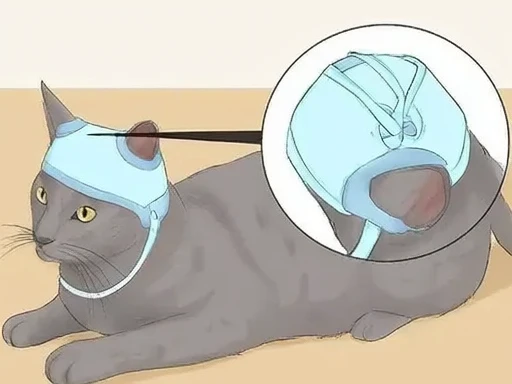
A gray cat lies on a beige floor with a light blue EEG cap secured on its head. A magnified circle highlights the cap's straps, showing how they are tied under the cat's chin to keep it in place.
3

Secure the EEG cap. After you have put the cap on your cat, you will need to secure it to prevent it from slipping off. Most EEG caps have straps that can be tied under the cat's chin or behind their head. Make sure the straps are tight enough to hold the cap in place, but not so tight that they are uncomfortable for your cat.

  • If your cat seems uncomfortable or restless, check the straps to make sure they are not too tight.
  • You may also want to consider using a soft cloth or blanket to help cushion the cap and keep your cat comfortable.

Warnings

  • Do not attempt to put an EEG cap on your cat without the guidance of a veterinarian or qualified technician. Improper placement of the cap or electrodes could cause injury or inaccurate results.
  • If your cat becomes distressed or aggressive during the EEG procedure, stop immediately and consult with your veterinarian.

Qwen3.5-9B fine-tuned on wikiHow articles, illustrated by a Qwen-Image-2.1 style LoRA.

LoRA fine-tuningQwen3.5-9BQwen-Image-2.1ZeroGPU
Hugging Face →

An LLM that speaks Toronto

A collection of language models fine-tuned to speak Multicultural Toronto English at a volume no actual Torontonian has ever reached. Not research. Just a fun little side project.

Let’s talk!

Always happy to talk LLMs, EEG, psychometrics, or a strange side project.